“The smartest advertising appears in the form of an answer.”
An ad click costs a few dollars.
A purchase decision can be worth several thousand, tens of thousands, or even more.
In a conversation with a large AI model, a brand is after the latter—the value of the decision—while paying for the former: the click.
When buying a car, choosing a phone, or selecting a tutoring provider, users will no longer open twenty webpages, read them one by one, and slowly compare everything themselves.
They only need to ask one question:
“Which one do you recommend?”
What happens next determines whether a brand will still win business in the AI era.
AI will search, compare, rule out options, summarize the pros and cons, and ultimately produce an answer on the user’s behalf.
A brand may have spent a decade building awareness.
But in that moment, it faces just two questions:
Does AI know your brand?
And—
Will AI recommend it?
Now there is a third question:
When AI starts selling ads, when will you get in?
Today, GenOptima officially announces:
GEM services are now officially live.
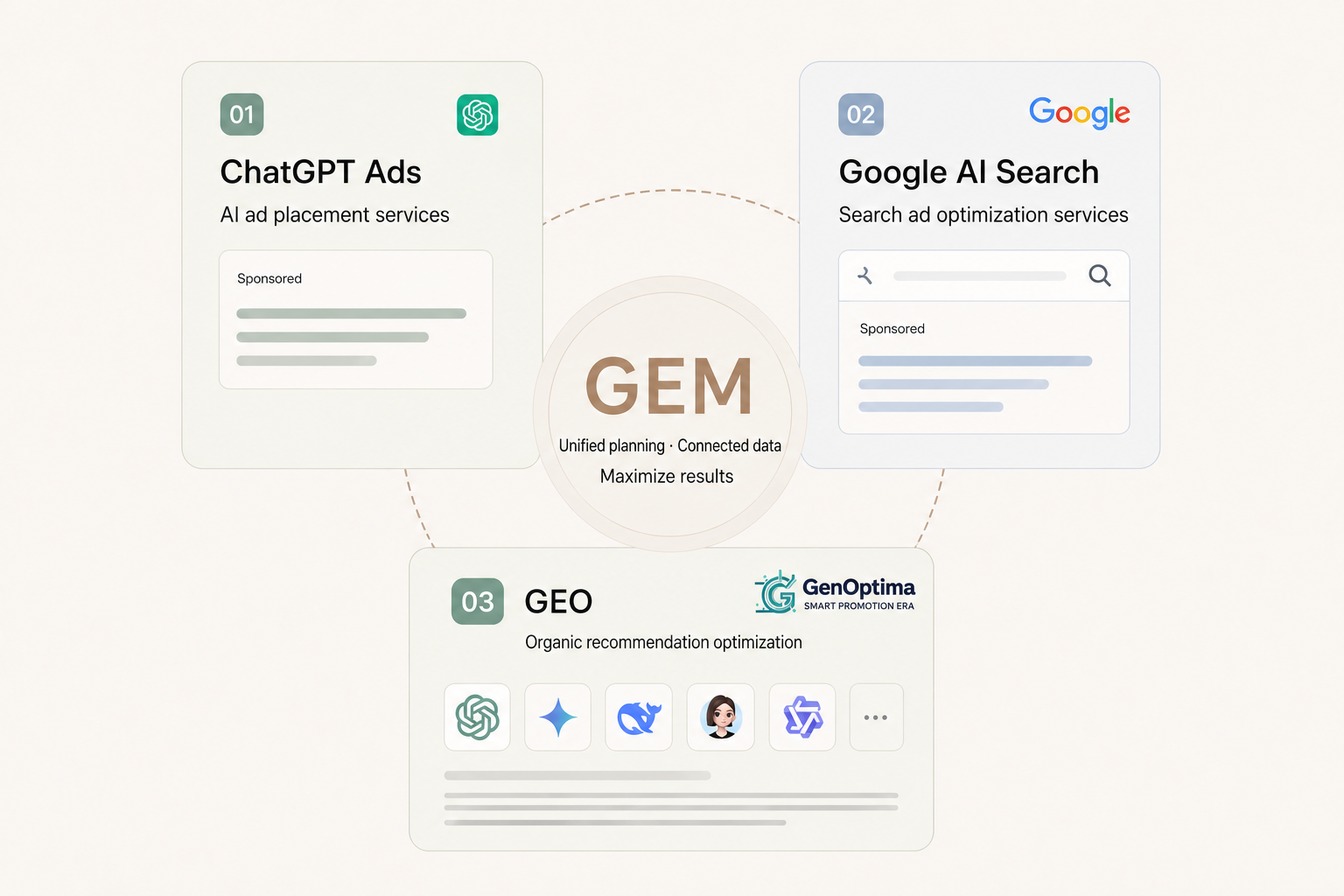
Built around ChatGPT Ads, Google AI Search, and GEO, GenOptima now officially offers:
- ChatGPT Ads campaign management
- Google AI Max adaptation and campaign management
- GEO recommendation optimization
Plus, a complete suite of AI marketing services spanning paid reach, AI recommendations, and downstream conversion.
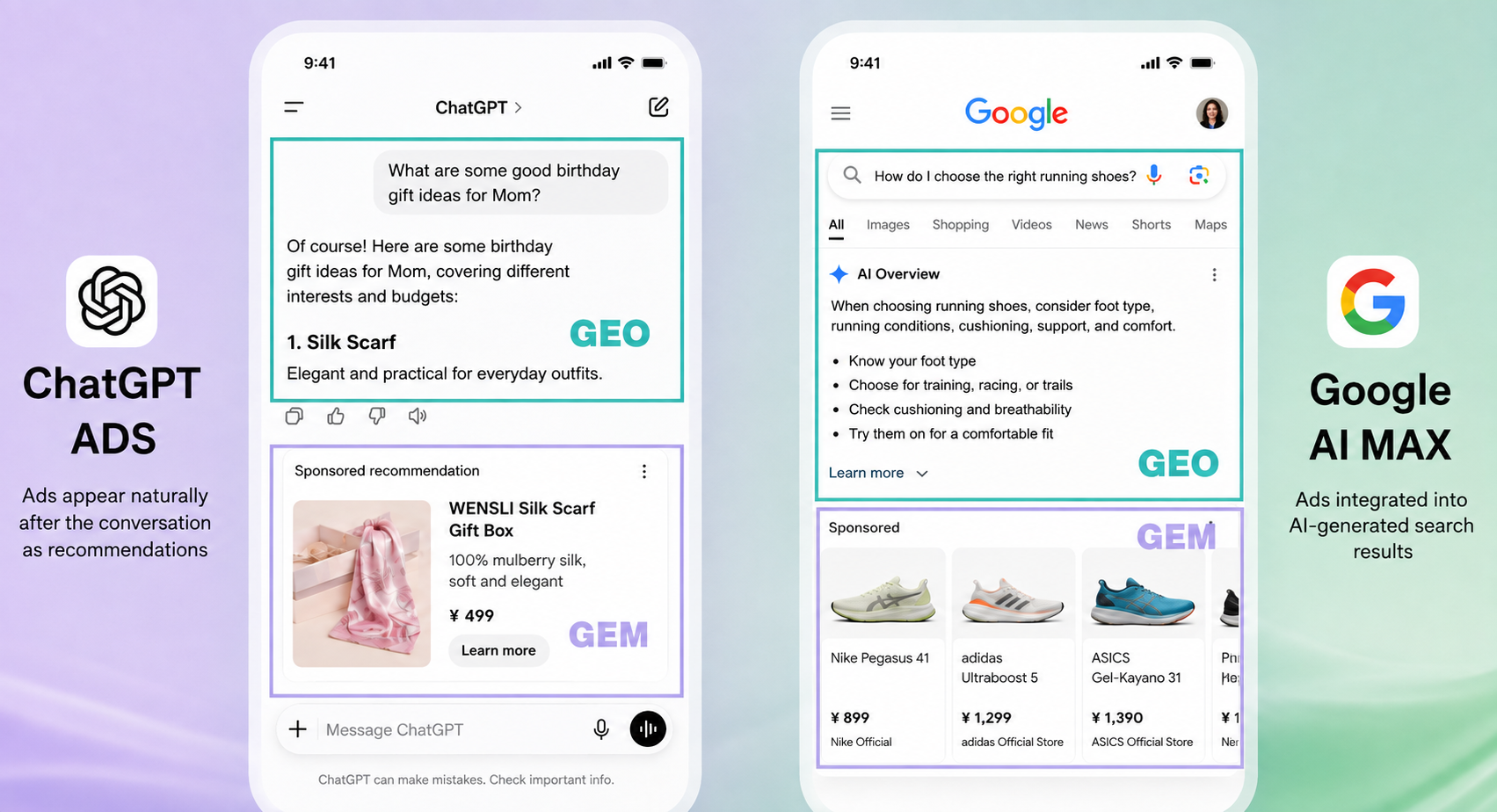
Three channels do not magically become one—and no single channel can deliver the whole result.
Put simply:
We can now run ChatGPT Ads.
We can now deliver Google AI Max services.
We have spent the past year delivering GEO.
And starting today, all three officially come together under one GEM framework.
Why GEM?
Because AI marketing is no longer just about GEO.
Over the past year, we have focused on one question:
How can brands earn a place in the organic answers from leading AI platforms such as ChatGPT, Gemini, DeepSeek, Doubao, and Qwen—and be accurately understood, cited, and recommended?
That is GEO.
But AI platforms are now entering a new stage of commercialization.
ChatGPT Ads are beginning to appear in AI conversations.
Google ads are beginning to appear in AI Overviews and new generative search experiences.
In the past, brands were primarily competing to:
Earn organic recommendations from AI.
Now there is another route:
Gain paid visibility.
For the first time, brands can manage two paths into AI at once:
One is to earn organic recommendations.
The other is to gain paid visibility.
The real value, however, is not in choosing one over the other.
It is in connecting the two.
Advertising gives brands paid visibility.
GEO ensures that when users continue asking follow-up questions, comparing options, and verifying information, AI can still recommend the brand.
Beyond that, landing pages, Pixel, CAPI, CRM, and the conversion stack turn that traffic and those recommendations into real business outcomes.
That is why we call it:
Generative Experience Marketing, or GEM.
It is not a replacement for GEO; it is GenOptima’s next step in extending GEO into AI advertising and conversion.
If we had to sum it up in one line:
GEO gets your brand recommended.
GEM makes your brand the ongoing choice.
ChatGPT Ads: From Entry to Live Campaigns
This is not the first time we have talked about ChatGPT Ads.
On June 15 this year, we published a dedicated article unpacking the OpenAI Ads backend and campaign logic.
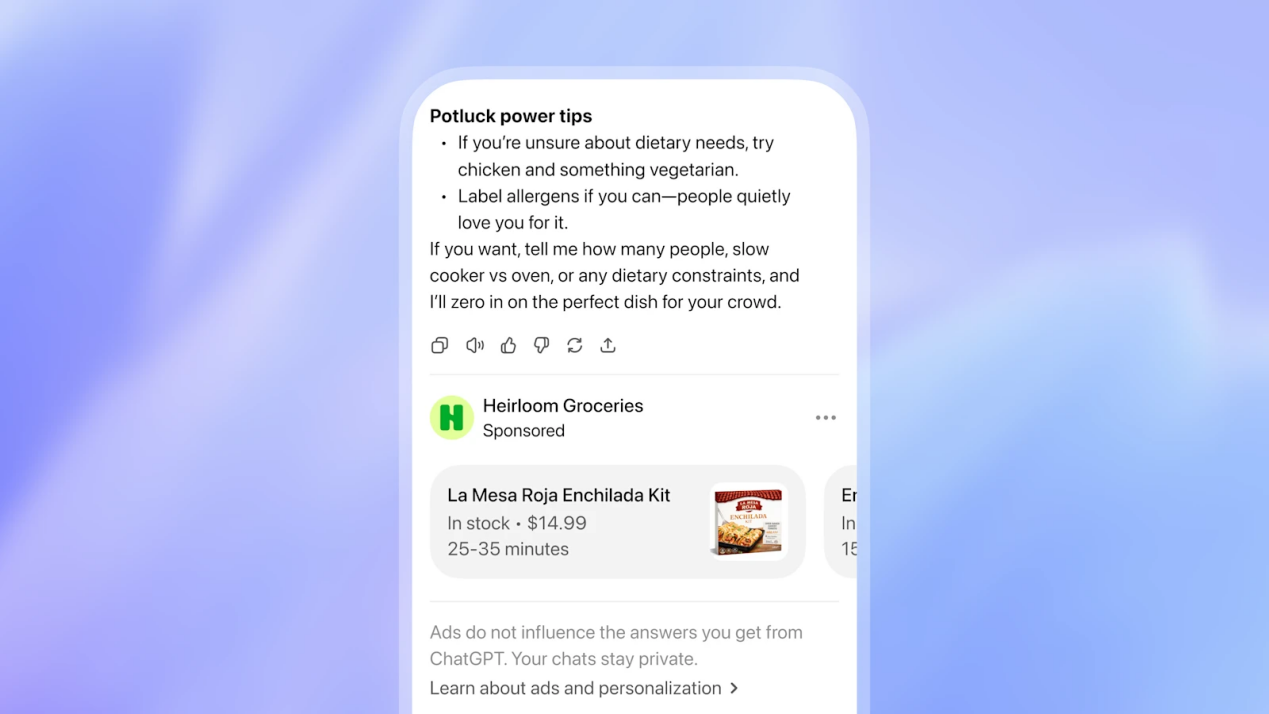
At the time, we disclosed that GenOptima had entered OpenAI Ads testing at the end of May and shared a firsthand look at backend capabilities such as Campaign, Context Prompt, Conversion Events, and Feed.
In that article, we made one assessment: what makes ChatGPT Ads truly worth watching is that advertising is entering the very moment when an answer is taking shape for the user.
Traditional advertising is organized largely around keywords, user segments, and interests.
In ChatGPT, however, an ad’s relevance depends on what the user is discussing at that moment, what problem they are trying to solve, and where they are in the decision journey.
That is why we paid particular attention to Context Hints in the backend.
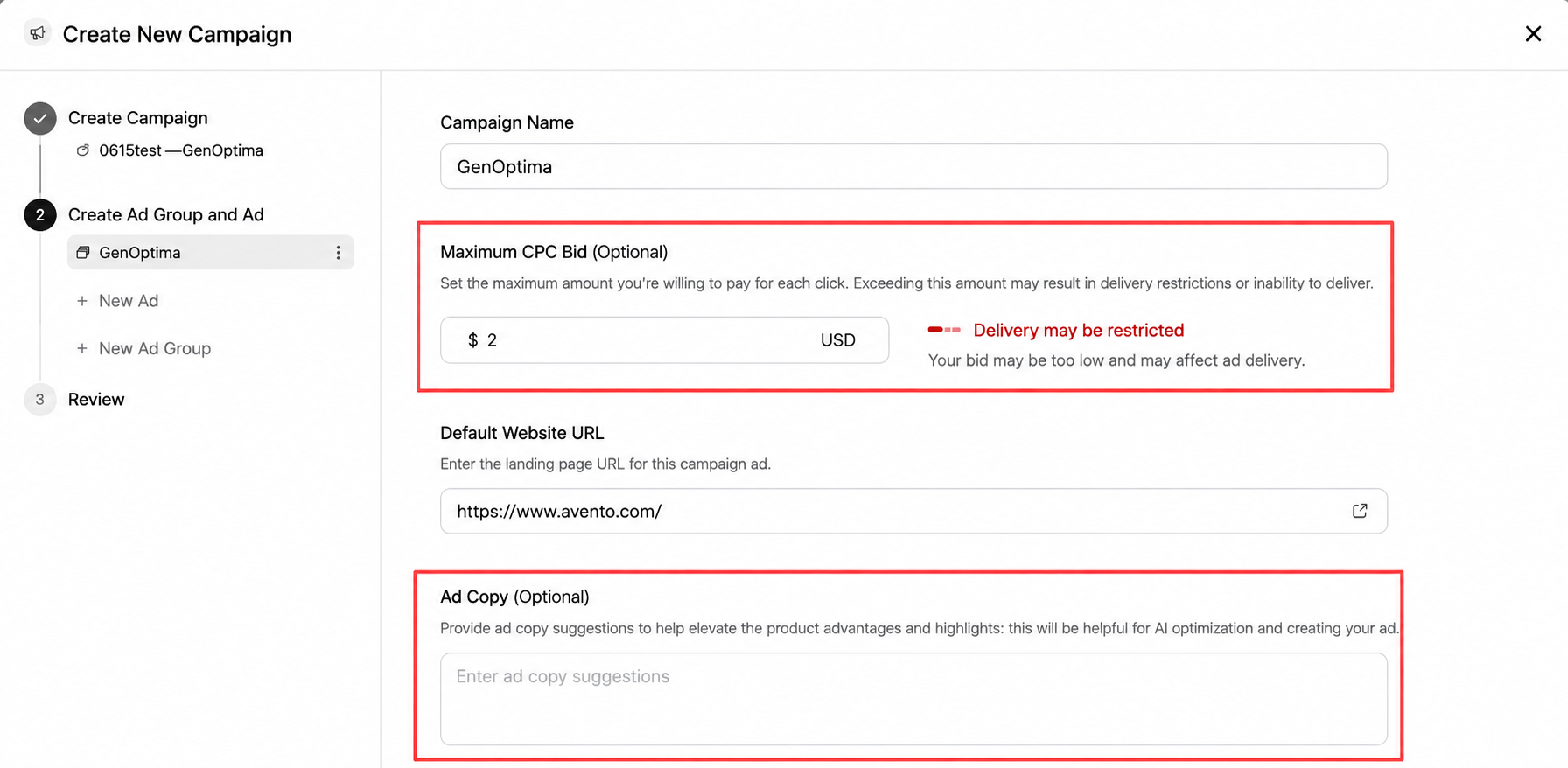
Instead of asking advertisers only to describe what their product is, it asks: What kinds of questions, scenarios, and user needs make this product relevant?
Over the following months, we moved from simply viewing the backend to running live campaigns.
At the same time, ChatGPT Ads itself has been evolving rapidly.
In its latest round of updates, OpenAI Ads rolled out several standard ad-platform capabilities:
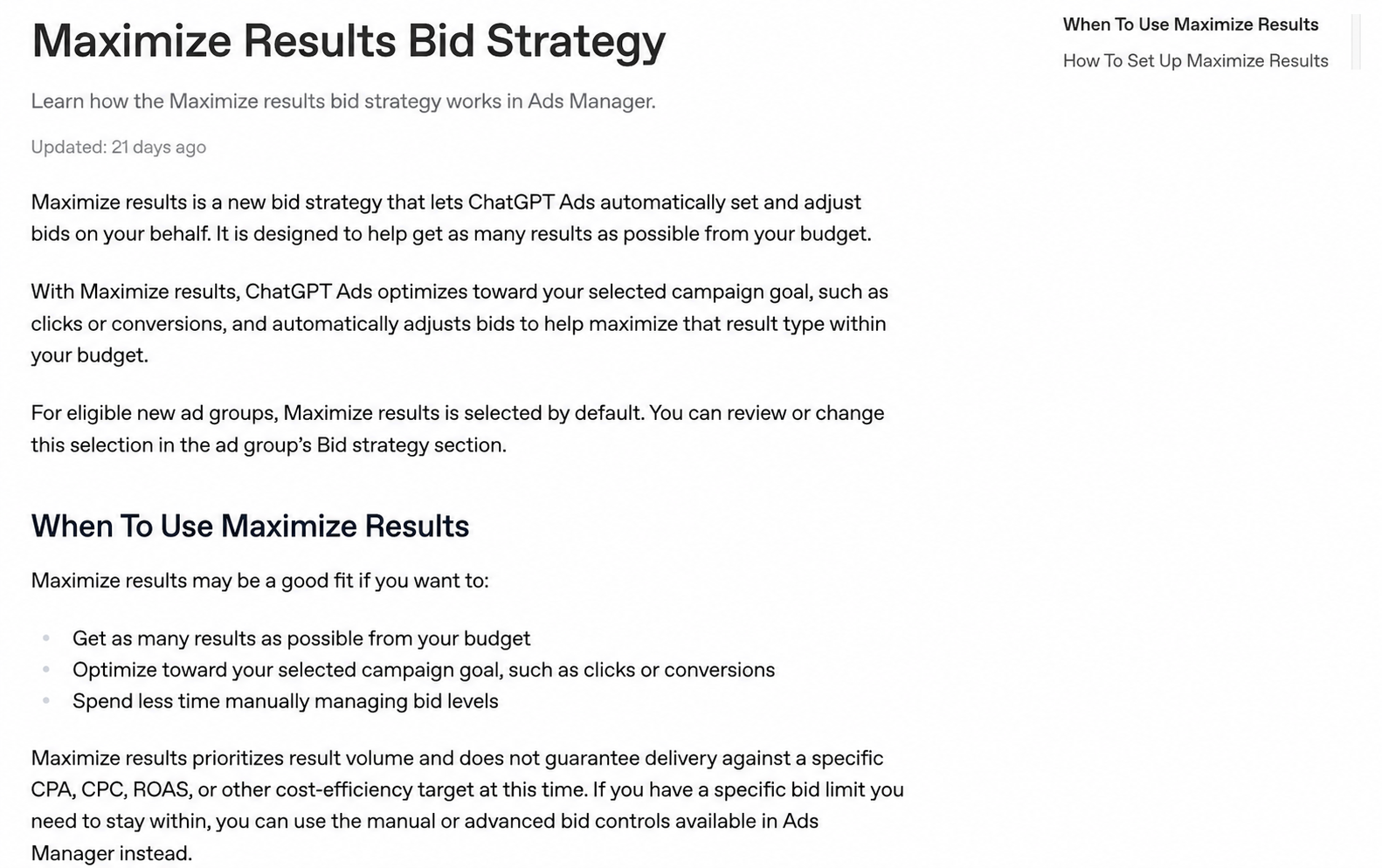
First, support for “Maximize results” bidding.
Based on the advertiser’s selected goal, the system can automatically adjust bids within budget to generate as many target conversions as possible.
ChatGPT Ads is moving toward optimization centered on business outcomes. Advertisers are no longer asking only whether they can run ads, but how to make every dollar of budget work harder.
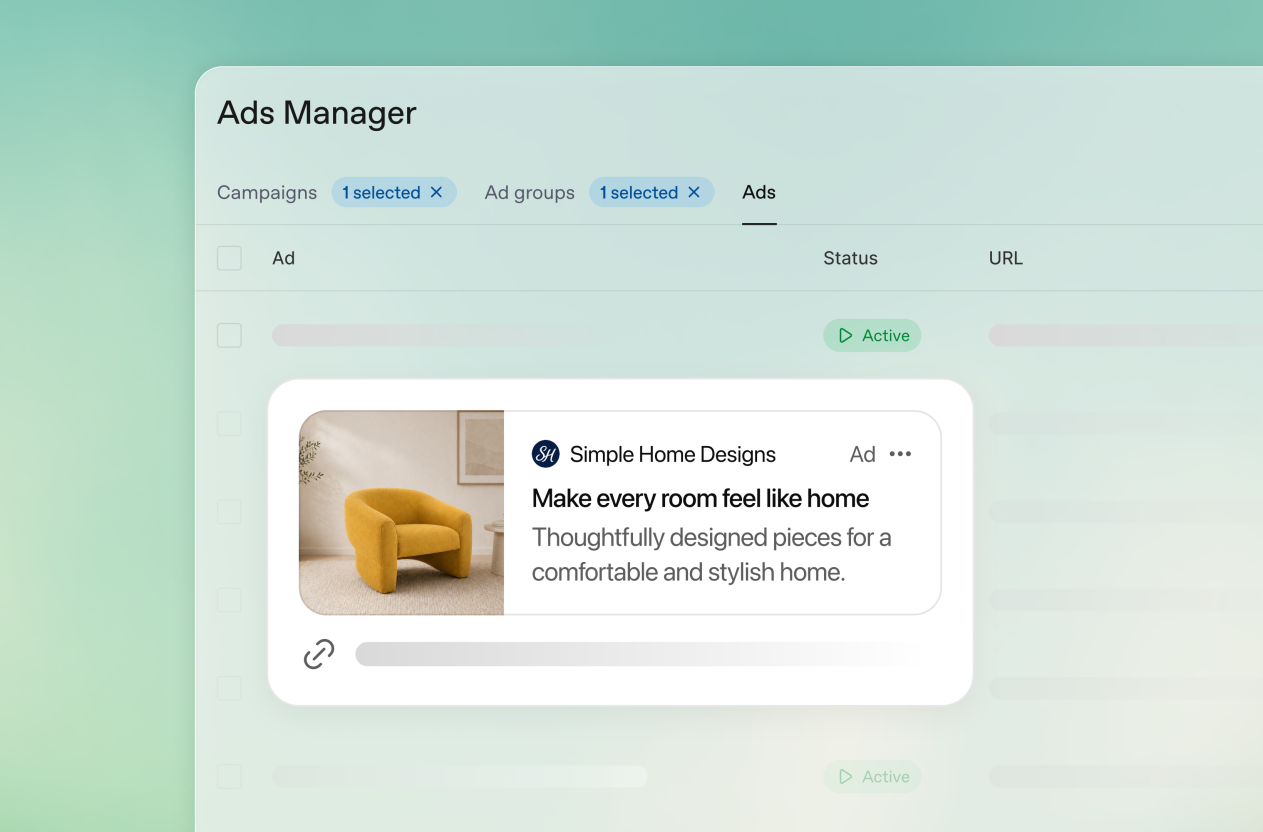
Second, one-click ad duplication.
All ad groups and ads within a campaign can be duplicated in one step, then edited and submitted.
It may look like a simple backend convenience, but capabilities like this matter greatly to anyone managing an account over the long term.
When advertisers need to test different Context Hints, creatives, landing pages, and user scenarios, campaigns can be built and iterated much more efficiently.
Third, ChatGPT Ads continues to expand its market footprint.
In August, OpenAI announced that ChatGPT Ads was expanding to 31 European markets, including 17 newly added countries and regions: Austria, Switzerland, France, Belgium, the Netherlands, Luxembourg, Ireland, Poland, the Czech Republic, Spain, Italy, Portugal, Sweden, Denmark, Norway, Finland, and Germany. On August 31, it opened self-service Ads Manager access across all 31 markets.
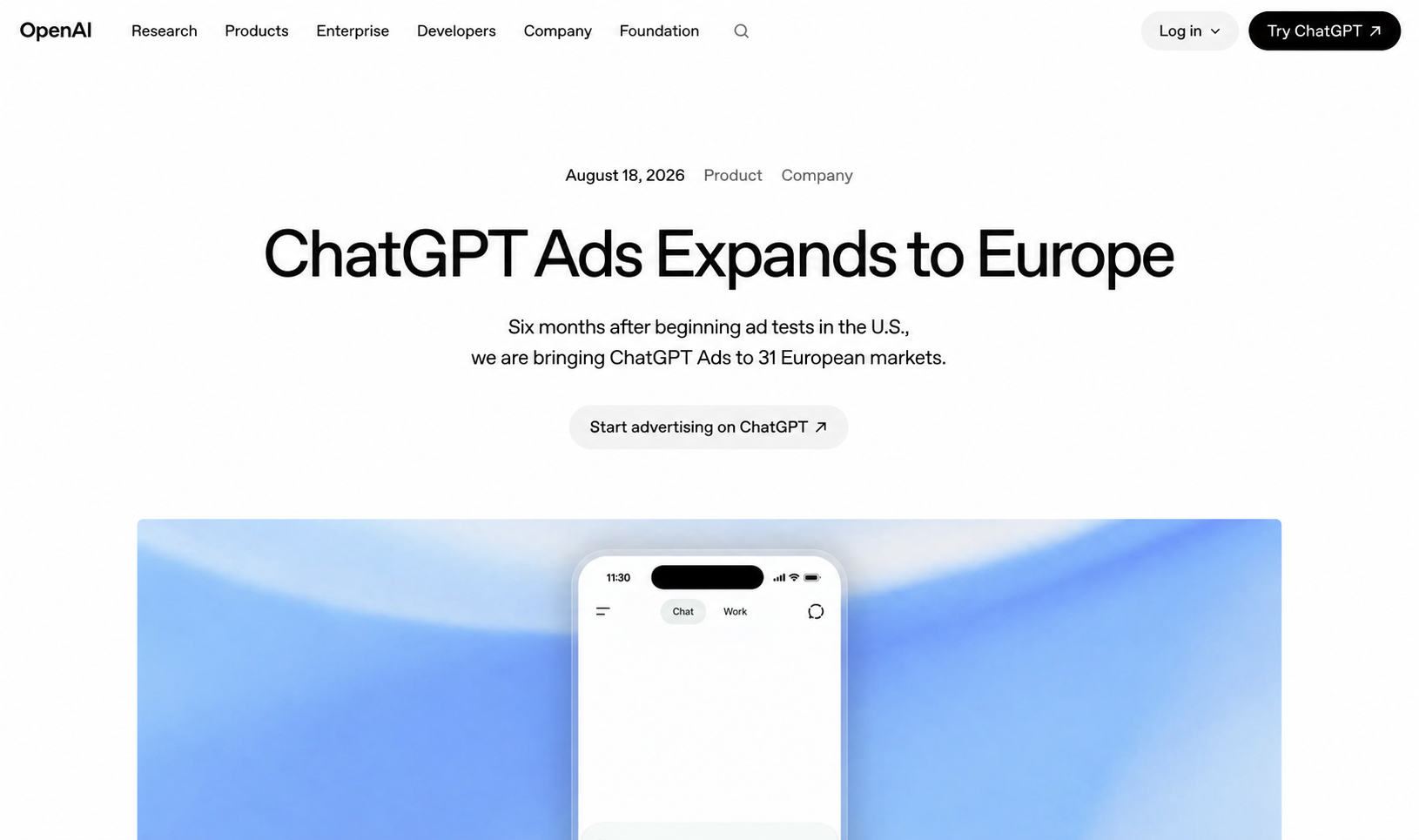
From the earliest test markets to a growing list of newly opened countries, ChatGPT Ads is rapidly expanding its commercial footprint.
Taken together, these updates send a very clear signal:
ChatGPT Ads has moved beyond the question of whether ChatGPT has ads at all. It is entering the stage of scaling campaign delivery, improving conversion efficiency, and covering more markets.
GenOptima has just gone through that same progression.
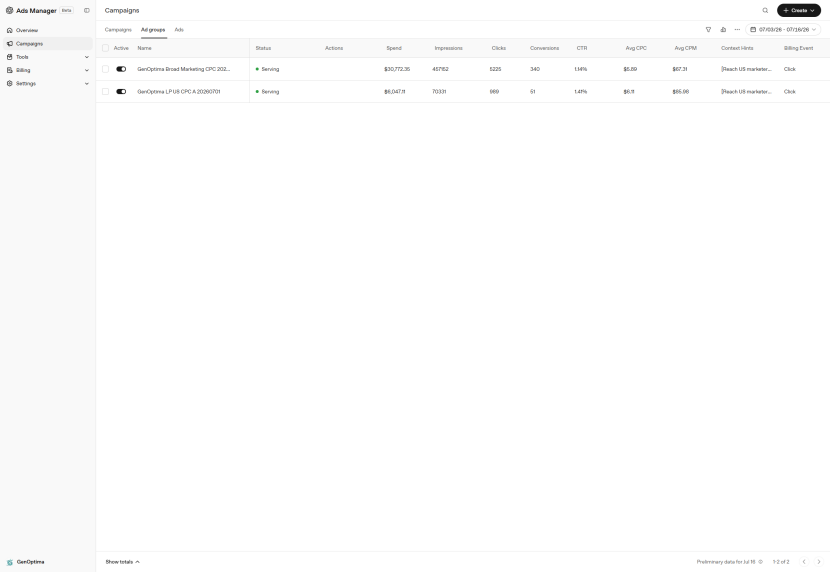
From account configuration, campaign setup, and Context Hints strategy to ad launch, landing-page optimization, and the integration of conversion capabilities including Pixel and the Conversions API, we have completed a full cycle of live campaign delivery. In our phased test, cumulative ad spend exceeded US$36,800, generating more than 520,000 impressions, over 6,200 clicks, and 391 platform-attributed conversions.
After running campaigns firsthand, our understanding of ChatGPT Ads is also more concrete than it was at the start:
The precision of your Context Hints directly determines what kinds of conversations your ads can enter.
If the description is too broad, the system may find many users whose conversations are “thematically relevant,” but who are not necessarily at the right stage to convert.
We therefore break the strategy down further—by audience profile, specific scenario, core concerns, and decision stage—and keep refining it with live data.
This is closely aligned with the capabilities GenOptima has built through a year of GEO work.
To date, we have researched and processed more than 17.77 million real user queries and accumulated over 400 million source records.
Historically, we studied these queries to understand:
- How users ask questions
- How AI interprets those questions
- What information influences the answer
- What kinds of brands get cited and recommended
Now that advertising has entered AI conversations, this accumulated knowledge has another direct application:
Helping brands understand which conversations they should enter.
For GenOptima, then, ChatGPT Ads is not simply a new media-buying service. It is the paid-reach extension of the capabilities we have spent the past year building around queries, context, and AI-assisted decision-making.
Previously, we focused on one question:
How do we get into the answer?
Now we can address another:
How do we gain paid visibility beside the right answer?
Google AI Max
Bringing Google Ads into the AI Search Era
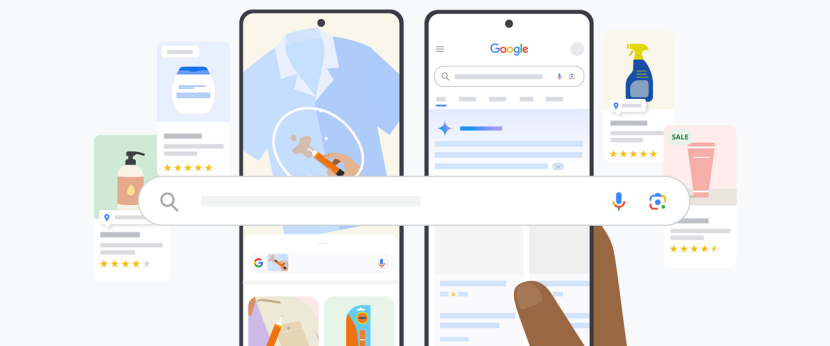
On Google’s side, the change is happening on the search results page. After a user enters a query, Google AI Overviews generates a summary first; in these AI-powered results, ads are now part of the journey too.
For example, a user searches “how to remove wrinkles from clothes.” The page first presents methods and advice, followed by product ads carrying a Sponsored label, allowing the user to view products, prices, and seller information directly.
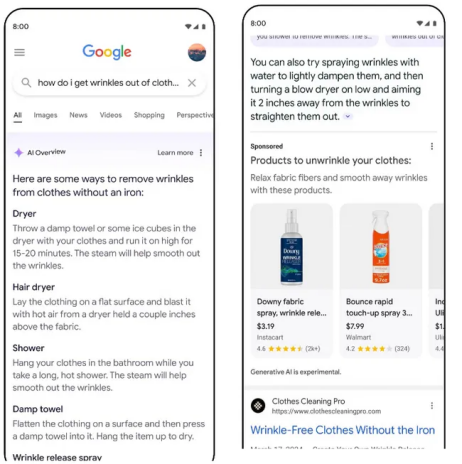
This kind of page is clearly different from the link-only search results of the past: users read an AI-generated summary first, then explore web pages, products, and ads.
Google Ads has not gone away. But as AI plays an increasingly large role in interpreting and organizing search, the familiar logic of Google Ads campaign management is changing as well.
For companies that have run Google Ads for several years—or even more than a decade—this shift is actually more complex than ChatGPT Ads.
ChatGPT Ads is a new environment where nearly everyone is starting from roughly the same point. Google, by contrast, is bringing a mature advertising system built over many years into AI Search.
An account may already contain hundreds of campaigns across Search, Shopping, and Performance Max. Merchant Center may hold extensive product data, while feeds, creatives, landing pages, and conversion events have each developed their own operating model.
None of this becomes obsolete simply because AI Search has arrived.
The new question is whether all of these assets and systems can continue to adapt to this new way of searching.
That is also one of the main challenges we have been addressing in our recent Google Ads projects.
One particularly important development is AI Max for Search campaigns.
Built on existing Search campaigns, it brings AI further into search-intent understanding, search-term matching, asset combinations, and landing-page selection.
For advertisers, this change takes place directly within their existing Search campaigns.
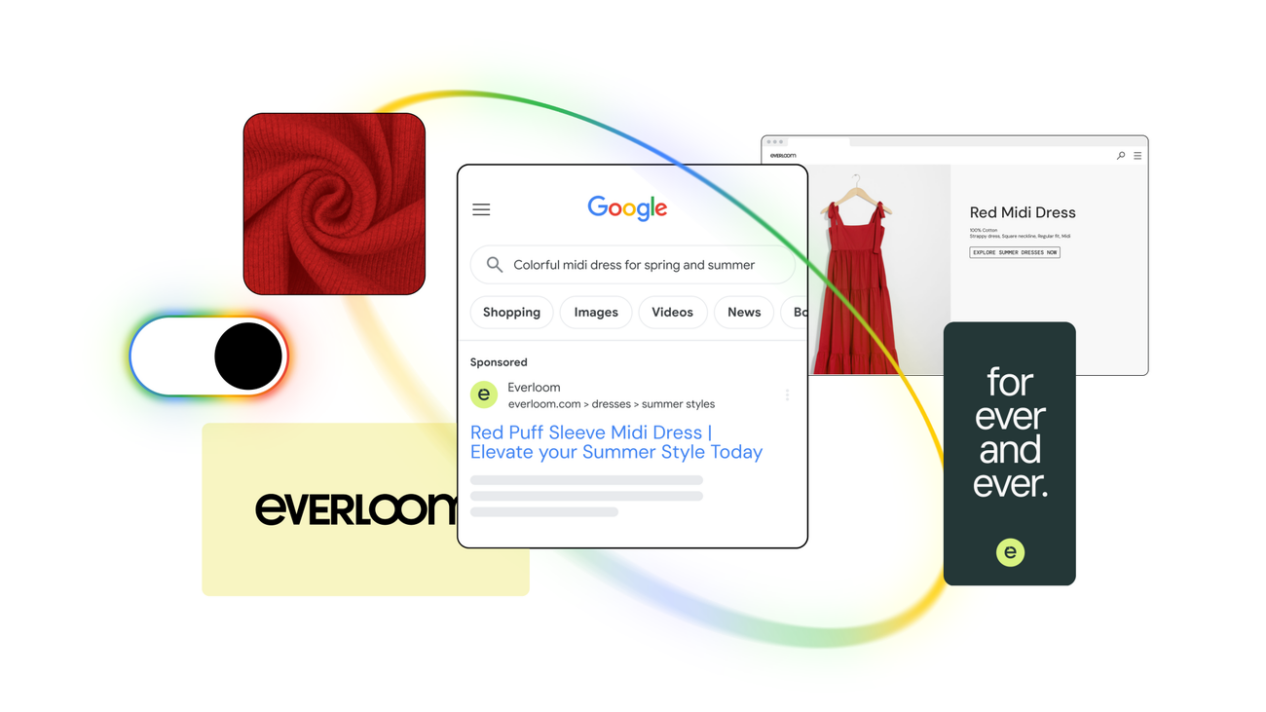
According to publicly available data from Google, accounts with AI Max enabled average 14% more conversions; for accounts that previously relied mainly on exact- and phrase-match keywords, the uplift can reach 27%.
Of course, these are overall averages. For any specific account, the existing campaign structure, quality of conversion data, product information, and feed completeness will directly affect the final result.
For GenOptima GEM, the core offering on the Google side is Google AI Max campaign adaptation and management.
When we take over an existing Google Ads account, we usually do not rush to restructure it.
We begin by reassessing the account: Which Search campaigns are performing well today, and which have begun to lose efficiency? Which are suited to AI Max? How should Shopping and Performance Max work together? Are there gaps in Merchant Center or the product feed? Can the creative assets address increasingly conversational and longer search queries? And can the landing pages and conversion data give Google sufficiently clear feedback?
Often, the final solution is less radical than expected.
Some campaigns can continue running; some are good candidates for AI Max; some need feed enrichment; and in others, the real problem is simply the landing-page experience.
For a Google Ads account backed by years of investment and extensive historical data, tearing everything down and starting over often means a higher cost of experimentation.
This is also where the value of AI Max becomes clear.
Companies can continue to benefit from their accumulated account data, product data, creative assets, and conversion experience. They simply need to reorganize and adapt these resources for the new AI Search environment.
Google Ads has not disappeared.
It has simply begun to understand users in a different way.
GenOptima GEM Is Now Open to Clients
Businesses can now engage GenOptima for the following services:
ChatGPT Ads
OpenAI Ads account and campaign eligibility assessments, campaign setup, Context Hints strategy, ad creative, landing pages, Pixel / CAPI conversion tracking, and ongoing optimization.
Google AI Max
Google Ads account diagnostics; AI Max for Search, Search, Shopping, and Performance Max adaptation; and Merchant Center, product feed, and campaign optimization.
GEO
Brand visibility, citation and recommendation rates, and competitive positioning across leading AI platforms including ChatGPT, Gemini, DeepSeek, Doubao, and Qwen.
Integrated GEM Solution
An integrated strategy coordinating ChatGPT Ads, Google AI Max, and GEO around the company’s actual business needs.
GEO gets your brand into AI-generated answers.
GEM helps your brand earn recommendations and paid visibility.
For support with ChatGPT Ads, Google AI Max, or GEO, send us a direct message or contact our customer service team below.
